By HANNA NICKLES
Voice correspondent
FIRST PUBLISHED IN THE JUNE 23, 2026, ISSUE OF THE HOT SPRINGS VILLAGE VOICE. REPRINTED WITH PERMISSION.
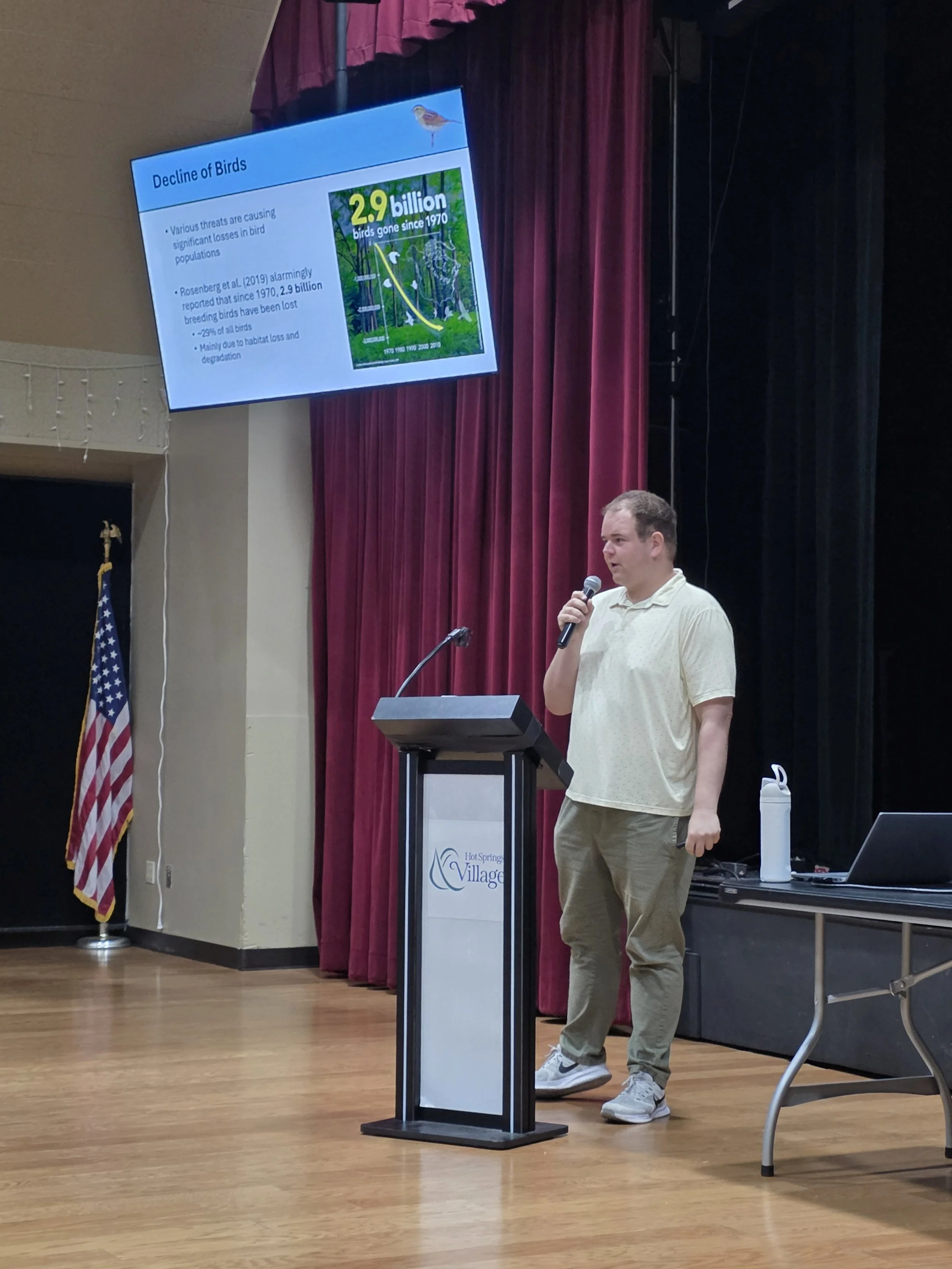
Hot Springs Village Audubon held its monthly meeting on June 11, featuring speaker Kevin Krajcir, a conservation biologist and grants coordinator at the Arkansas Natural Heritage Commission. Also known as ANHC, the organization focuses on preserving natural diversity and promoting a balance between development and environmental protection in Arkansas.
Krajcir’s presentation was titled “Habitat Associations and Responses to Prescribed Fire of Wintering Henslow’s Sparrows in Southern Arkansas,” in which he discussed the research he has been working on at the ANHC and the concerning decline in the population of Henslow’s sparrows.
The Henslow’s sparrow is a rare grassland species that primarily lives in saline barrens, habitats that have high concentrations of salt and magnesium in the soil. In the winter, the birds migrate to the woodlands and grasslands in the southeast, including southern Arkansas.
Little is known about the habitat preferences of the sparrows in Arkansas because the state does not have longleaf pine savannahs, which are most common in Louisiana, Alabama, and Florida.
“This species is sharply declining as a lot of grassland birds are. Based on eBird, it seems they’ve lost about 5 percent of their population across their breeding range from the 10-year period from 2012 to 2022,” said Krajcir.
Krajcir’s study recreated research completed 20 years prior, updating the surveys of Henslow’s sparrows by examining their habitat and assessing for potential threats and conservation strategies to help increase the population.
To do this, Krajcir and his team walked through the barrens from mid-November to mid-February to count the sparrows. Krajcir described the process as “very tricky” and said the birds were similar to mice because they did not make noise.
The areas surveyed included the Hall Creek Barrens, Kingsland Prairie, Longview Saline, and Warren Prairie. Krajcir took GPS points where the sparrows were found and then used Google Earth to measure the size of the barrens, comparing the barren size in relation to the number of sparrows found.
With the help of a botanist, Krajcir and his team used a dissimilarity index to look at vegetation types in correlation to where sparrows were and were not.
The study found that sparrow abundance was positively correlated with barren size. “The bigger your bearings, you’re gonna have more sparrows,” Krajcir said.
Compared to the Holloman study, the sparrows had moved closer to the nearest edge of their habitat. According to Krajcir, “In the original study by Holloman, they found that the sparrows were, on average, about 29 meters from the closest edge…typically closer to the forest. In our study, we found that they were about half that distance closer to the woods.”
The speaker emphasized the importance of prescribed burns, explaining that the sparrows avoid areas where vegetation grows too thick. Krajcir said that the most sparrows were found in areas that were burned every one to two years, marking the most ideal prescribed burn schedule for the species.
HSV Audubon will not meet in July or August, and the next scheduled meeting will occur on September 10 with speaker Kristen Robinson to give a talk about wild turkeys.
For additional information about the Arkansas National Heritage Commission, visit arkansasheritage.com. Those who are interested in more information regarding HSV Audubon can visit https://hsvbirds.org.