By MARY ELIADES
Voice correspondent
FIRST PUBLISHED IN THE APRIL 21, 2026, ISSUE OF THE HOT SPRINGS VILLAGE VOICE. REPRINTED WITH PERMISSION.
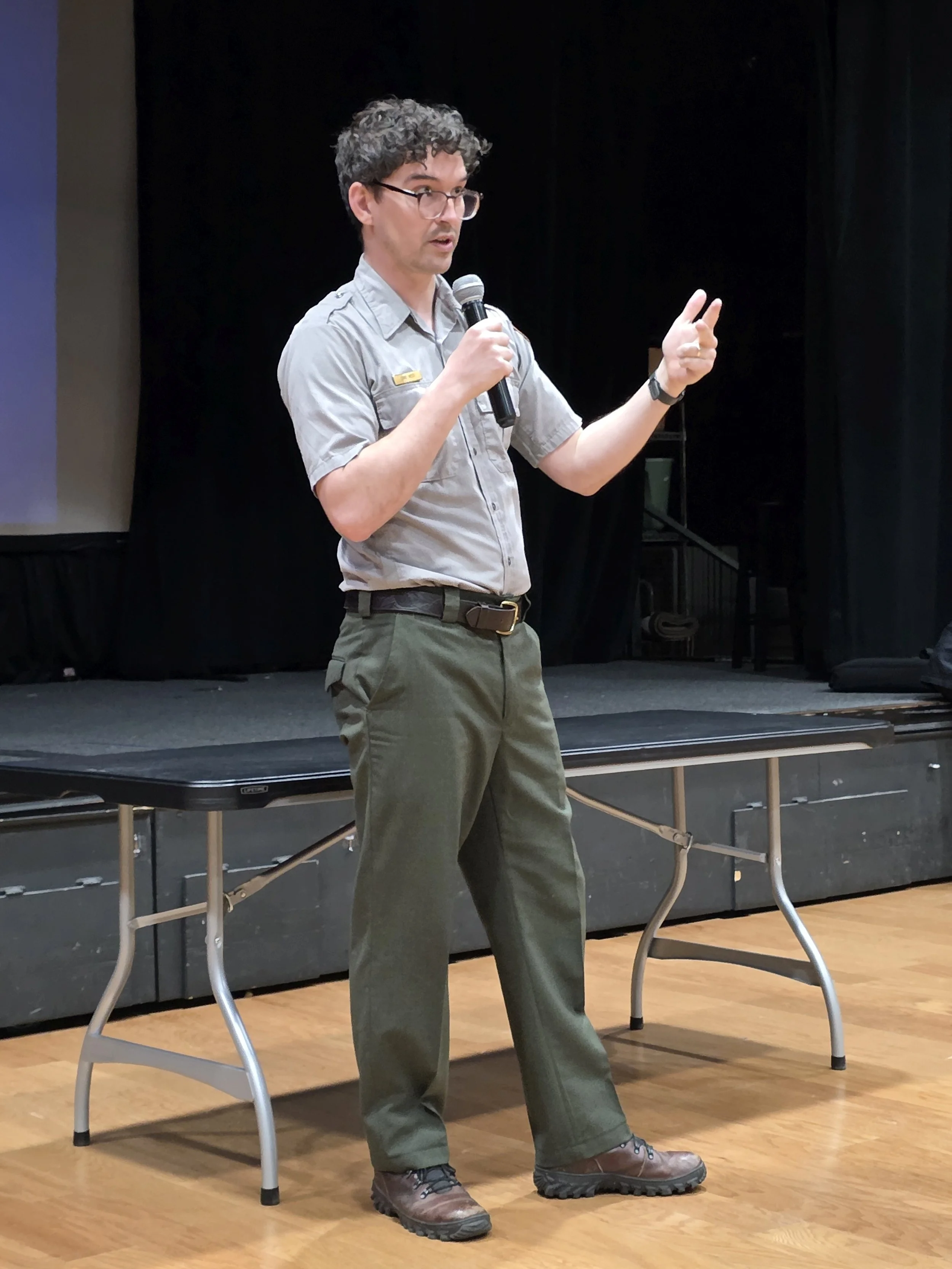
Dr. Cane West, academic historian and park ranger at Hot Springs National Park, was the guest speaker at the April 9 meeting of HSV Audubon, where he presented a program on “Hot Springs and the National Park Idea.”
West began his talk by describing the “creation story” of Hot Springs National Park. “Nothing exists as Hot Springs National Park without the water,” he said. The Hot Springs Recharge Zone – a 22-square-mile area that extends beyond the boundaries of the park – acts as a massive underground funnel that collects rain and snowmelt, filters it through the rock layers of the surrounding mountains, adds heat because of the natural thermal gradient, and shoots the hot water up through faults, or fractures, in the brittle rock along the base of Hot Springs Mountain.
Although Native Americans had been familiar with the site for centuries, it wasn’t until the 1803 Louisiana Purchase and the 1804 Hunter-Dunbar expedition that the healing properties of the waters were recognized by a wider public. “The Hunter-Dunbar expedition put Hot Springs on the federal map,” said West.
Once the Hunter-Dunbar expedition reported on its findings, the visitors started coming.
“We began as a giant hospital,” West said. “Or, as some people in the National Park Service would call it – ‘Doctor Nature.’”
In 1832, legislation was enacted to set aside the lands as a federal reservation – “the first time in the history of the United States that the federal government preserved a natural resource for public use,” said West, and predating Yellowstone by 40 years. “It’s the idea that the mountains can heal and the water can rejuvenate.”
West said three main factors contributed to the rise of Hot Springs as a health destination: rampant diseases, many of which are water borne, spreading through U.S. cities, making access to clean water “one of the greatest public health interventions of the 19th century”; increasing modernity, with new technology improving communication and railroads opening up the country; and investment – often by railroad magnates – in bathhouses and infrastructure (including hotels, brothels, and gambling facilities).
Beautiful Victorian bathhouses were built, with bridges over the creek running through the middle of town, so patrons could come to be cured of a variety of maladies and then cross the creek for other entertainments.
The Roosevelt Arch, at the north entrance to Yellowstone, is inscribed “For the Benefit and Enjoyment of the People,” a quote from the Organic Act of 1872 establishing Yellowstone National Park, and West emphasized the egalitarian nature of the facilities in early Hot Springs. While wealthy patrons stayed at the Arlington Hotel and visited the nicest bathhouses, those less fortunate could visit public or private bathhouses and free pools.
West said that when some of the bathhouse owners banded together to try to get rid of the public bathhouses, the local community fought back, signing petitions and taking their suit to Congress, to “permit the healing waters of Hot Springs to be made available for every citizen who chooses to…visit our city, be he white or black,” he added.
Congress eventually passed legislation to define Hot Springs “as a place where not only could you go if you can pay, but also…if you can’t pay,” West said. “Hot Springs is for the people…a place for all…to receive healing from nature.”
West said these ideas were part of the beginning of a public health service, and Hot Springs boasted local clinics and a free medical dispensary. Professional, licensed physicians practiced holistic healing, with programs incorporating group activities, hydrotherapy, and prescribed hikes on the trails behind the bathhouses. “The park was designed as a giant health space,” said West, “a landscape of wellness.”
West said that in 1900 there were around 500 mineral spa resorts in the United States, and in 1915 one-third of all visitors to national parks visited Hot Springs National Park – more than any other national park. In addition to the springs, visitors were drawn to the cultural and social activities: Oaklawn, golf, baseball spring training, and, of course, gambling. At its peak, the park boasted one million baths taken every year.
By 1957 medicine had greatly improved and visits to the springs dropped. West said today’s numbers may not be what they were in 1915, but the Fordyce Bathhouse currently receives 1,400 visitors every day. “Every generation has a different connection to the water,” he added.
Hot Springs National Park will host multiple free, family-friendly events during Hot Springs National Park Week (April 18-25) as part of its year-long celebration of America’s 250th birthday. West said, “These events, based around Hot Springs National Park’s birthday, celebrate America’s beauty and stories while seeking to inspire the next generations through the legacy of protecting the nation’s history, landscapes, and natural wonders.”